

Is it worth investing in fiber internet?
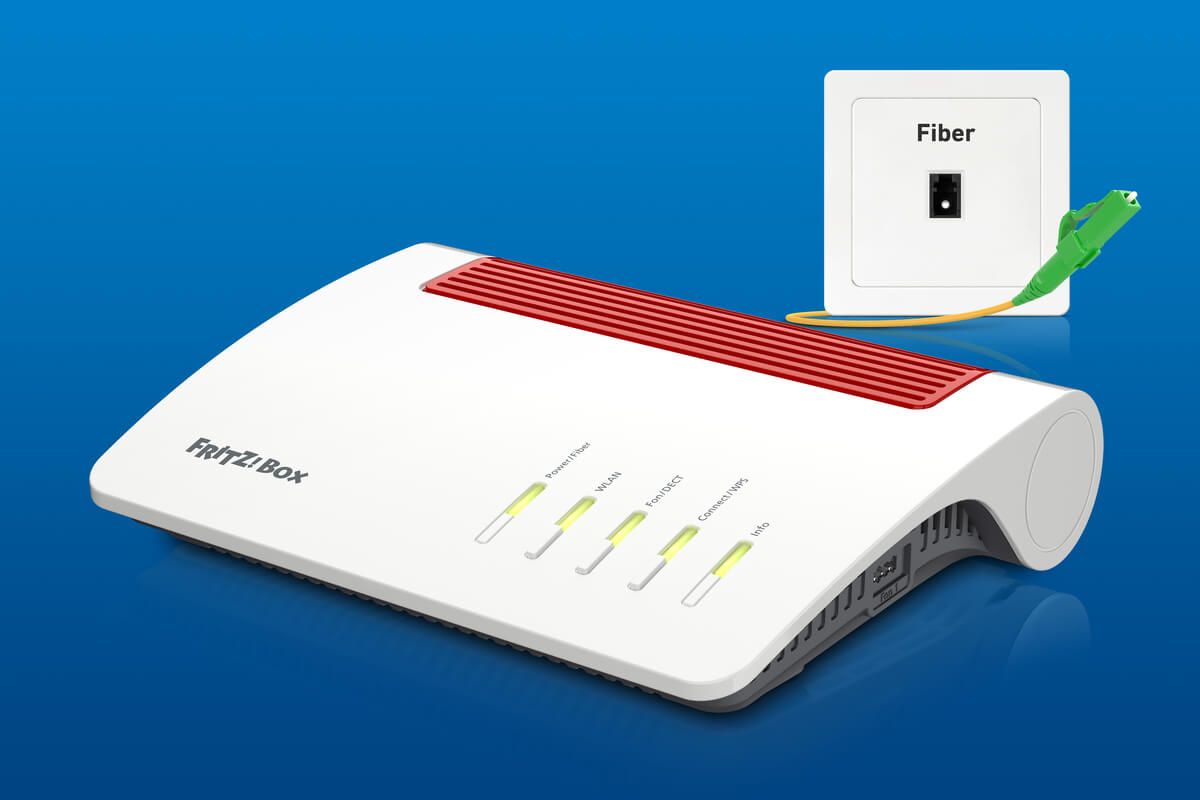
Yes! It is definitely worth making the small effort of searching the Internet for fiber optic Internet access offerings in your area. What's more, the "investment" will probably cost us only this moment of time, since subscriptions for very fast fiber-optic lines, with a capacity of 700 - 1000 Mbit/s (or gigabit) do not cost more than in the case of other access technologies and oscillate within the range of 50 - 100 zlotys. So, if only we have such an opportunity in our locality, we should as soon as possible switch to by far the best technology for fixed Internet access, which is just fiber optics.
Advantages of fiber optics
An optical fiber is a very thin, flexible glass fiber in which a beam of light is transmitted. With the help of light pulses, a digital signal is encoded for data transmission. Since glass by its nature is a brittle and fragile material, the core of the fiber is shielded by several layers of plastic, providing protection against mechanical injury.
Unlike cable or telephone lines, or those based on antenna cables (cable TV), in fiber optics there is no current flowing, but just light pulses, generated by an LED or laser. Thanks to this, the signal can be transmitted uninterruptedly over long distances (up to tens of kilometers) without the need for regeneration or amplification. Thus, in practice, there is no problem known, for example, from telephone lines, consisting in the fact that the farther our location is from the exchange, the signal has poorer quality and the Internet connection has lower bandwidth.
Fiber optic signals are actually quite immune to interference, and are completely unaffected by electromagnetic interference. Thus, there can be dozens of individual fibers in a single pooled cable, between which there is no "crosstalk", so the data is transmitted unimpeded as if we were using a single fiber.
Fiber optic cables have almost unlimited bandwidth, calculated in giga and terabits (in laboratory conditions, even close to 180 Tb/s has been achieved!), although links up to 10 Gbit/s are used in commercial applications, and individual and corporate subscribers are quite commonly offered links up to 1 Gbit/s. Such speed is successfully sufficient for all applications we can imagine today.
Advantages of fiber optics however, they do not end with high speed. Paradoxically, fiber optics, while being the most advanced access technology, is also perhaps the cheapest medium. This is because glass is made from silica, or sand, of which there is an endless supply. Fiber optic cables are therefore relatively inexpensive, e.g. an already finished cable (in a sheath, with pre-installed plugs on the ends) is now the cost of a. about. 100 zł. Wholesale prices for raw wire used by operators are much lower.
What fiber optics gives you service providers? Cheap and easy to maintain medium. Thus, building the infrastructure is not more expensive than other technologies. In addition, up to 64 users can be connected to a single fiber (after the use of so-called splitters), so by pulling up, for example, one cable to an apartment block, we can use it to supply Internet to 64 apartments, without the need to amplify the signal.
What fiber optics gives you
The advantages and disadvantages of fiber optics are best considered in comparison with another technology, such as xDSL. We have already mentioned gigabit speeds, which, for example, VDSL2 does not even come close to (in practice, a maximum of 300 Mbit/s, on very short stretches of copper cables, no longer than a few hundred meters). Prices for FTTH services are no higher than for xDSL, and due to lower network construction costs, fiber optic infrastructure is growing rapidly and can be expected to soon displace other technologies from the market.
The only disadvantage of fiber optics may be that it is much more difficult to connect the cables yourself, or to install plugs on them. This is because such operations require specialized equipment to precisely "weld" the glass fibers, which are less thick than a human hair. However, in specialized stores, or on the Internet, you can inexpensively buy ready-made fiber-optic cables of all kinds, along with accessories (vias, connectors, adapters for different standards, etc.), which can be used for the cable.).
Switching to fiber optics or is it worth it also replace its currently operating subscriber equipment with a fiber optic router? Probably yes, but it is not necessary, especially since sometimes - due to, for example, formal restrictions imposed by operators - it may be difficult or even forbidden to connect one's own router directly to the fiber optic cable.
On the other hand, to the question of which is better, optical fiber or LTE, it is difficult to answer, since we are trying to compare here anything different technologies. If we assume that we use LTE stationary and do not require mobility from the link, fiber optics will still be a firm favorite, if only for its higher bandwidth, independence from weather and radio wave propagation.
