

Wi-Fi 6 - what distinguishes the new standard?
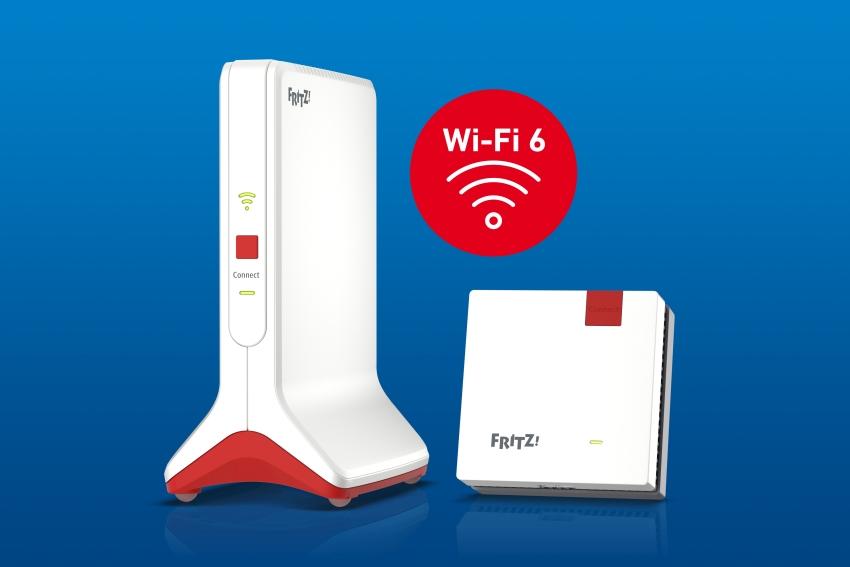
Wi-Fi 6 - what sets the new standard apart?
Wi-Fi 6 offers faster speeds and better performance, bringing with it a number of important breakthroughs and innovations. The somewhat confusing names are also changing - for example, IEEE 802.11ac or Wireless AC for short. With the transition to Wireless AX, version numbers were introduced: meaning that Wi-Fi 6 is now IEEE 802.11ax. The name change is intended to make the identification of wireless standards more user-friendly and is a recommendation of the Wi-Fi Alliance, a non-profit organization that promotes wireless technology worldwide.
OFDMA - more efficient
Multiple simultaneous 4K streams, video chats, downloads and cloud applications are an integral part of everyday life - no problem for FRITZ!Box with Wi-Fi 6. Where previous versions reached their limits, the use of OFDMA ( Orthogonal Frequency Division Multiple Access) in Wi-Fi 6 allows portions of the radio channel to be assigned to different devices, improving performance and allowing more bandwidth per data stream. Another advantage of OFDMA is significantly reduced latency, which is of particular interest to gamers.
High speeds with 1024-QAM
Wi-Fi 6 also significantly improves Wi-Fi speeds over its predecessors. In environments with particularly high densities of wireless devices, such as in residential buildings, data throughput can be increased by up to 40%. The decisive factor is a better modulation scheme up to 1024 QAM (quadrature amplitude modulation). Using the available radio spectrum, which is much more efficient, also increases the ratio of net to gross data rates compared to older wireless standards.
Big jump for 2.4 GHz
Since Wireless N (Wi-Fi 4) technology was released 10 years ago, the connection characteristics and data rates in the 2.4 GHz frequency band have remained largely unchanged. Meanwhile, innovations and significant improvements have been made primarily in the 5 GHz band. With Wi-Fi 6, that's changing. Huge benefits accrue to devices that transmit data only in the 2.4 GHz band. In addition to greater capacity for multiple simultaneous connections, data transmission speeds have almost doubled.
This is especially important given the ever-increasing number of home devices and peripherals with integrated Wi-Fi (e.g., smart speakers, robot vacuum cleaners, smartwatches), as they often only dominate the 2.4 GHz band.
Greater security and longer battery life
Battery life of smartphones and other mobile devices will also benefit from new Wi-Fi 6. Intelligent wake mechanisms (Target Wake Time) determine how long devices can "sleep" between transmissions, saving energy.
