

Wi-Fi 6E
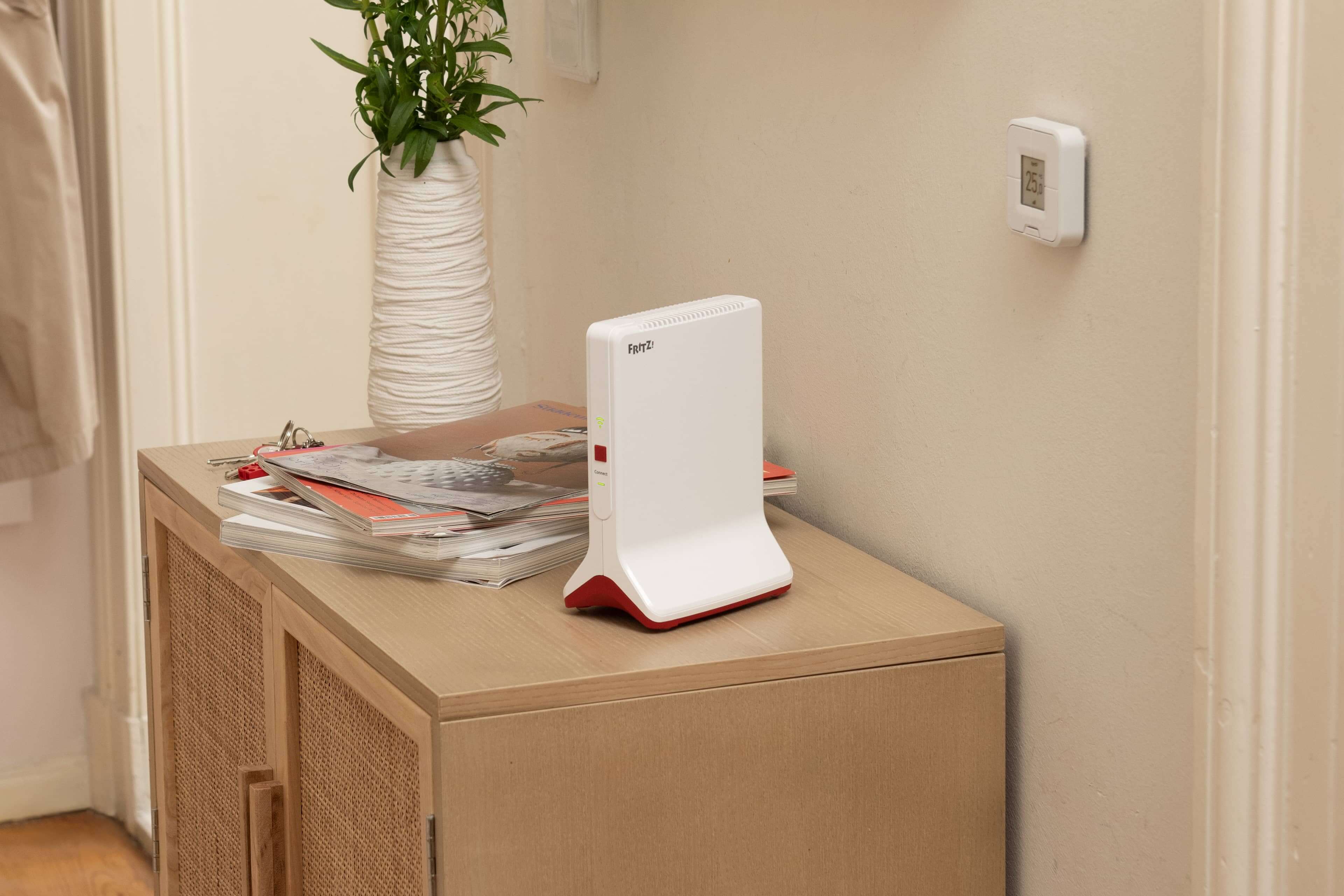
Latest Wi-Fi standard - faster and more efficient connection
Wi-Fi 6E is a development of a standard that is finding an increasingly wide range of users WiFi 6, who have implemented fRITZ routers, achieving net speeds of 1200 and 2400 Mbit/s in the 2.4 GHz and 5 GHz bands, respectively. New "6E" version moves transmission to brand new 6 GHz radio band.
In terms of the technical solutions used, Wi-Fi 6E, is not a completely new technology. OFDMA modulation, improved signal strength management mechanisms compared to Wi-Fi 5, lower latency, implementation of techniques to reduce interference from neighboring networks in a given location, and use of 160 MHz wide channels are virtually identical to Wi-Fi 6.
Contrary to the expectations of the reader, accustomed to the idea that every new development is all about more bandwidth, the nominal speeds achieved by the new Wi-Fi standard are basically the same as in Wi-Fi 6. So what is the novelty of the new standard?
The power of Wi-Fi 6E lies in its use of the brand new 6 GHz radio band, which has not been used by the individual user until now. It is important to realize at this point that in the 5 GHz band, where Wi-Fi 6 operates, only two, high-speed transmission channels of 160 MHz were available. We can imagine that Wi-Fi 6 is a highway for fast, sporty cars that has only two carriageways. In addition, devices belonging to government infrastructure, such as weather radars, also operate in the 5 GHz band, which in some locations prevents or limits the use of these two high-speed bands, and residential customer devices must crowd into 80 MHz channels. Wi-Fi 6E is like a brand new, and seven-lane highway for racers, as there are as many as seven 160 MHz channels available in the 6 GHz band.
More bandwidth for demanding applications
Wi-Fi 6E is not so much faster Wi-Fi, but rather more efficient Wi-Fi. With as many as seven, wide transmission channels, devices at a given location can develop full speed, offering demanding applications the bandwidth they need. Importantly, all of these applications will be able to use large amounts of bandwidth simultaneously.
Reduced latency and smooth data transmission
Currently, the biggest devourers of Internet bandwidth are all kinds of streaming platforms. In addition, smooth data transmission is required to transmit and display high-definition video along with multi-channel surround sound.
It is not difficult to imagine a house or even an apartment with two 4K TVs in two rooms, on which household members, such as those of different age groups, want to simultaneously watch their favorite series. If there happens to be an additional passionate Internet gamer in the same premises, who, to top it all off, takes a liking to dynamic FPP shooters, in which small transmission delays determine life or death, even theoretically fast Wi-Fi 6 may prove insufficient with the simultaneous high bandwidth demands on the radio network. Wi-Fi 6E may be a better option in this situation, as it has a wider data highway.
When discussing modern technologies based on high frequencies, such as 5 and 6 GHz, it is important to remember that transmission in this band will be fastest in a relatively short distance from the access point, that is, preferably approx. 10-15 m. At the same time, high-frequency signals are more easily attenuated by obstacles such as walls, so it is all the more important to place our router thoughtfully in the house.
When buying a new router, it is definitely worth investing in a device that supports Wi-Fi 6. If we have end devices (laptops, phones, televisions) that support Wi-Fi 6E and we know that in our case fast, simultaneous transmission will be a requirement, it is worth opting for a router with Wi-Fi 6E. Otherwise, I guess you should rather wait for Wi-Fi 7, which is expected to bring a doubling of speeds and is already implemented in routers, such as the latest FRITZ model!Box 5690 Pro.
