

Wifi signal booster from FRITZ!Repeater 6000 - gigabit wireless network
What could be the reasons why the Internet works slowly?
Such a broadly asked question is difficult to answer unequivocally, as the reasons why data packets travel too slowly from the server to the laptop held in your lap can be manifold. To make matters worse, not all of them are under our control and we manage to solve easily. It can't be helped, for example, that due to the ugly weather, most of the residents of our neighborhood stayed at home, lagged in front of their monitors watching YouTube videos, and thus saturated the resources of the local neighborhood connection.
However, we can make sure that at least the part of the network under our control, i.e. the Internet router, the internal home network (usually Wi-Fi) is supported by devices selected and configured perfectly to our requirements and according to local conditions.
How to speed up the Internet?
According to the assumption made in the previous paragraph, we will not try to solve the problems of the whole world, but will focus on our own home and office, and in particular on the local Wi-Fi network and some reasons for its slow performance, which can be solved by using an additional signal booster with special characteristics - FRITZ!Repeater 6000.
Wi-Fi networks use high-frequency wavelengths (2.4 GHz and 5 GHz), which makes it possible to transmit large amounts of data with them, but at the same time they are prone to interference and harder to penetrate obstacles, which sometimes translates into poor or no coverage in some rooms.
It also happens that even with a relatively strong signal, the achieved speeds are disappointing, and the reason for the problems may be interference from other networks, such as those operating in the same band and on the same channel. The ubiquity of Wi-Fi networks has at the same time become their bane, because almost every house has a separate "transmitter", covering several apartments with its range and in every direction. Just run any Wi-Fi scanning application to see how terribly crowded the ether is in the Wi-Fi bands, especially 2.4 GHz.
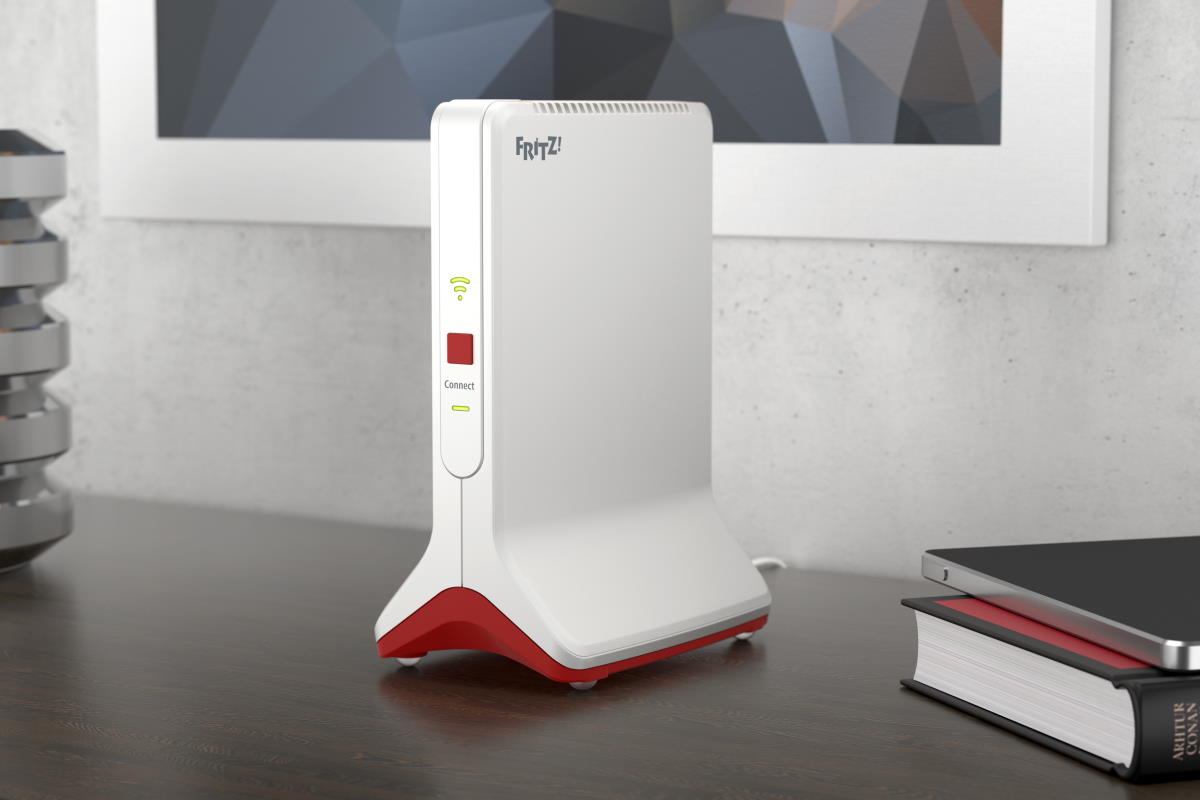
WiFi signal booster FRITZ!The Repeater 6000 will help solve most of these problems and can be combined with any router, although all its advantages will shine brightest in cooperation with FRITZ!Box.
We plug the device into the local network using an Ethernet cable (a slightly more cumbersome way, due to the need to lay a network cable, preferably at least CAT 6), and here's a note: there are up to two ports, one of which has a bandwidth of 1 Gbit/s and the other as much as 2.5 Gbit/s! One thing you can be sure of - the link between the router and the repeater will not be a bottleneck in our network. Thus connected amplifier will be "fed" the Internet through the cable, while locally the signal will be distributed by radio.
FRITZ radio interface!The Repeater 6000 deserves special attention because it is, in a sense, triple: it consists of two radio modules operating at 5 GHz and one at 2.4 GHz. This allows the device to support a large number of terminals, offering everyone optimal transmission conditions - especially since FRITZ!Repeater 6000 is compatible with Mesh and Wi-Fi 6. But why an additional 5GHz interface?
The second 5 GHz radio module is used for an easier way to install the amplifier. It provides a "wireless cable" of up to 2.4 Gbit/s to connect to a central router. It is a dedicated interface for creating a radio bridge through which data is flipped in bulk, so that the other interfaces are free to deal with phones, laptops and other devices using Wi-Fi.
